
Rethinking history with Laurent Guyénot, author of The Papal Curse
Rumble link Bitchute link Watch ad-free at my Substack
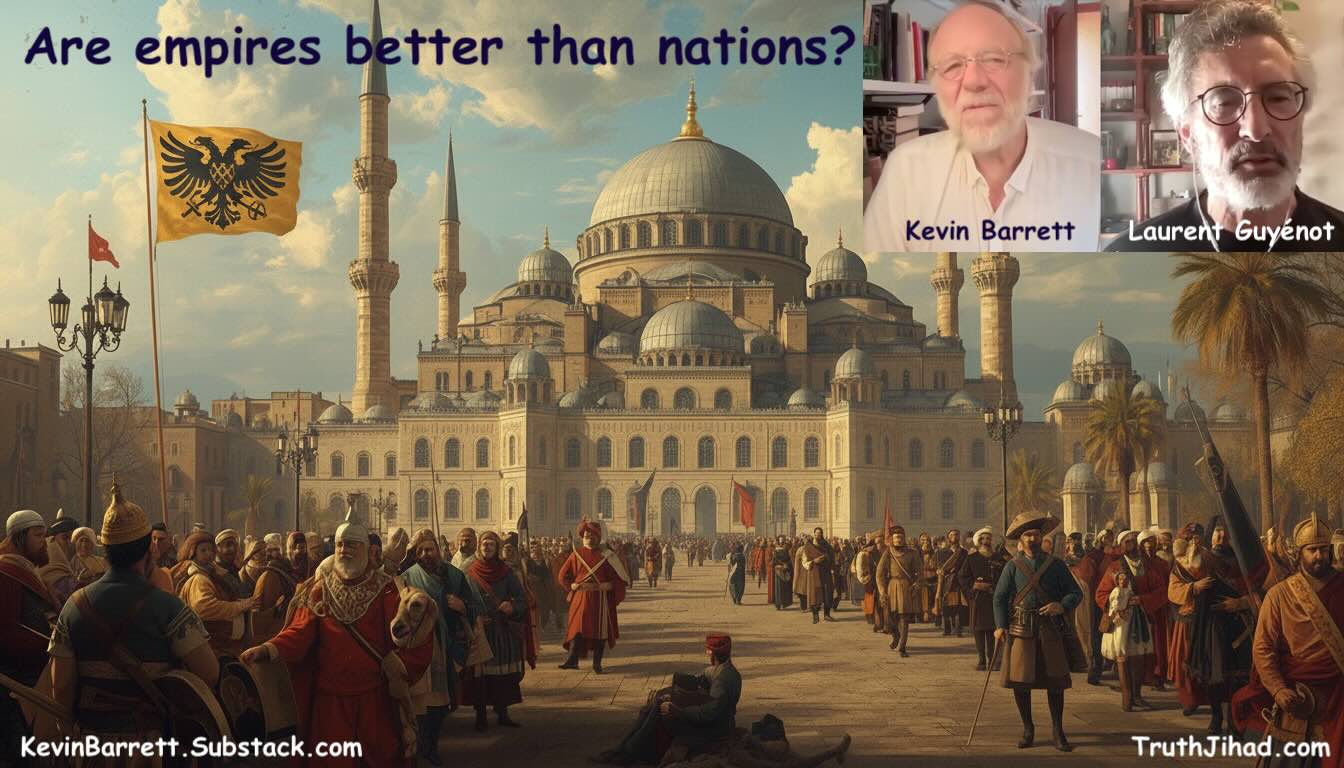
Laurent Guyénot, author of From Yahweh to Zion, discusses his new book The Papal Curse…and its implications for understanding where the world is going and why.
Kevin Barrett: Welcome to Truth Jihad Audio Visual. Kevin Barrett doing the audio since 2006 and the visual since a little bitafter that, unless you want to count my Hannity interview and stuff like that. Anyway, I’ve been looking for Truth, 9-11and otherwise, for going on 25 years. And one of the more important, noteworthy colleagues in that voyage has been Laurent Guyénot. He’s the author of From Yahweh to Zion, the only book that I was willing to spend a year and a half orso of my life translating, because it’s really important. And a lot of his other work is important too. So without further ado, welcome, Laurent. How are you?
Laurent Guyénot: Thank you, Kevin, for having me. I’m fine, thank you. So, I’ve been joining you in the fight for truth only 10 years,well, about 12 years ago. So, you know, you’re my teacher in that field, in everything, actually.
Kevin Barrett: Well, thank you. So, we’ve been together about halfway through the period since 9/11 and pretty much on the same page. With the Israel mainly did it thesis, which more and more people are starting to wake up to. You’re hearing whispers of that from people with tens of millions of audience members. If you add up Tucker Carlson, Candace Owens, and well, there have been a couple of others, I think, too. What’s his name? That famous podcaster guy?
Laurent Guyénot: Nick Fuentes, maybe?
Kevin Barrett: Yeah, him too.
Laurent Guyénot: Actually, him more than Carlson and Candace Owens, about 9/11 at least. It seems to me, from what I’ve looked at, Carson is not really saying Israel did it. He’s just saying they might have had foreknowledge or he’s still at this stage. So that’s why we’re looking forward to the 25th anniversary to see if the Israel did it theory is moving forward. I hope so.
Kevin Barrett: Well, yeah, Carlson is dropping a few nods and winks, I think. He’s just being very, very careful so as not to invite, you know, getting Charlie Kirked or something like that. But yeah, I think you were ahead of your time with that thesis. And the world is catching up to you. And so you have a couple of other very provocative historical theses as well. And that’s what we’re going to actually talk about today. Your book, The Papal Curse, has just come out. And it argues that the papacy, the institution of the Catholic Church, has really been more of a curse than a blessing for Christianity, for Europe, and for the world. Now, my many Catholic friends—and I probably have as many Catholic friends as any kind of group from another philosophy or religion outside of my own Sufi Muslim orientation—I have lots of Catholic friends, and most of them aren’t going to like this. But I think it’s a discussion worth having, and any book that you write is worth talking about. So let’s go for it. Let’s talk about The Papal Curse. So what got you started with this?
Laurent Guyénot: Well, I think my research really, it’s a prolongation, a continuation of my research on Yahwism, you know, on Israel, what is the essence of Israel. And in my In my book already, From Yahweh to Zion, that it translated, I kind of opened up the discussion about the Jewish question being actually the other side of the Christian question. How Jewish power kind of conquered the West. It cannot be explained without understanding Christianity’s relationship to Judaism. That was my starting point. But then having some background in the Middle Ages—
Kevin Barrett: You don’t look that old. (Just kidding.)
Laurent Guyénot: Yeah. Well, you know, my mind, my soul may be quite old. I don’t know.
Kevin Barrett: We’re about the same age, so you’re getting pretty old.
Laurent Guyénot: Yeah. Yeah, so anyway, I, well, actually, I had some kind of, how do you call it, epiphany. One day, it just hit me, the very simple truth that if you try to understand Europe, and that’s another angle, and those two angles kind of met in my mind, because…If you love Europe, you cannot but be struck by the fact that Europe is a disaster as a civilization today because Europe is fragmented. And so therefore, if you try to understand what’s going on in the world today with the multipolar order, with civilizational states or the civilizational area trying to find a new order, you cannot help but be depressed as a European by noticing that Europe simply does not exist politically. There is a kind of European Union government. Everybody in Europe hates them. They have no legitimacy. They have no sovereignty. Every country in Europe still has…
Anyway, the fragmentation of Europe, if you start to think about it—and it’s not natural to think about it because we just assume it’s the normal state of Europe. We just have been told, well, Europe is a Europe of nations. But if you really start to understand how Europe became a Europe of nations, if you’re a Christian, if you’re a Catholic, you will quickly understand that, well, that’s thanks to the Pope. And most Catholics who think the papacy did a good job are happy with Europe being a Europe of nations. They’re just not happy that Europe is not enough for a Europe of nations. And they’re not happy that nations, European nations, have lost their sovereignty. And so they’re kind of in a dilemma because they know, realistically, European nations are not players in the new multiple world. Only Europe has the potential to have a place and to resist colonization from the United States, or in the past from the Soviet Union.
So that’s the tragedy of Europe. And as I studied the Middle Ages, I realized it has been a tragedy throughout the history of Europe, ever since the fall of the Roman Empire. And it has been a tragedy not only for Europe itself, because Europe is in a state of civil war. If you think of Europe as a civilization, it’s a civilization which is destroying itself all the time. It’s a constant state of war, with each nation trying to outdo the others in terms of military technology. And so from many different standpoints, even from the standpoint of the war ideology that developed in Europe and the war technology, the military technology, this was all kind of motivated by the competition between nations, trying to either dominate Europe or at least not be destroyed by their neighbors. I mean, until World War II, that’s what it was.
And then there is this famous book by a German historian (Ernst Nolte) called The European Civil War. He says Europe is in a state of civil war. The First World War and the Second World War were basically European civil wars. Europeans killed each other in atrocious ways. They’ve been killing each other forever.
Kevin Barrett: Some historians say that’s the single biggest reason why Europe conquered the world in modern era of colonialism and imperialism. The two most plausible reasons I’ve heard are that (fragmentation into warring states forcing rapid development of military technology) and the printing press. The printing press made people become more educated and literate, and that enabled them to jump ahead in technology. And then, of course, having them fighting each other all the time led to advances in military technology, which they used to conquer the world.
Laurent Guyénot: Yeah, well, the printing press happened quite late. You know, Europe was in a state of civil war already for many centuries before, so I don’t think that’s a major factor. But yes, you know, so there are two sides to look at it, two ways tolook at it.
Kevin Barrett: Wait! You’re saying Europe was already conquering the world before the printing press?
Laurent Guyénot: No, I’m saying Europe was already in a civil war. .
Kevin Barrett: What I was saying is those are the two reasons given for Europe’s success in conquering and colonizing the world.
Laurent Guyénot: Okay.
Kevin Barrett: And so they’re kind of separate, right? In other words, I wasn’t saying that the printing press happened because of civil war. They (civil war and the printing press) were just two things that happened in Europe that set Europe apart.
Laurent Guyénot: Yeah, well, you know, from the printing press, you can say literacy and the industrial, the scientific revolution and so on. Yeah, of course. But if you look at what happened to China, for example, it didn’t have much to do with the printing press. It had to do with military superiority. Europeans came with their metal ships. They conquered the world basically with their military technology. And this military technology developed in a state of constant competition. There are many testimonies about that from the Middle Ages. Many people who noticed, you know, that Europe has always tried to find some kind of balance of power between the nations. But the reality is that you always want to be a little bit on top in the balance in terms of military technology. And then you make alliance with other nations, and then other nations have to make their own alliances. And then when two nations start to quarrel, it becomes a world war. That’s always been the story of the wars in Europe.
There are quite a few books. There are two kinds of books, actually. There are books written that take that as a positive aspect and say, well, that’s how Europeans became smarter, more powerful and conquered the world—because they are fragmented and therefore competition between nations stimulated creativity and so on. There is this kind of theory. Which is true, but if you look at the influence of Europe on the world and you start to realize, for example, that colonization…You start to realize that the way the Europeans colonized the world was also done in a state of competition. And so it became “if I don’t steal this land, somebody else will steal it.” It became this kind of mentality.
Kevin Barrett: That’s a Jewish-Zionist saying.
Laurent Guyénot: Exactly. But that’s exactly how colonization happened. So colonization was every European nation trying to take as much as they could. With no attitude of trying to civilize. The whole predatory attitude of the West was also a result of the fragmentation of the West. There was never in Europe a sense that, okay, we’re a great civilization, therefore we’re going to bring our civilization to the rest of the world. It’s never been the major incentive. The incentive has always been, let’s take it.
Kevin Barrett: But that’s a big ideology, right? Everything from Rudyard Kipling poems about the white man’s burden through la mission civilisatrice in France, which you’re, of course, familiar with, and so on.
Laurent Guyénot: Of course, there are always those two sides. At some time, Great Britain felt that they were the European empire. So they had this kind of confidence in their own civilization. But then they started to worry as soon as Germany became powerful and beat them after the Industrial Revolution. Germany got a little bit ahead of them. So then they turned against Germany.
Kevin Barrett: Right. So let’s get your thesis clear. That is, you’re arguing that without the Pope getting this power through the donation of Constantine and the invention of this forged document a thousand years ago that led to the Catholic Church that we know today, which considers itself to be above the other Christian bishops and so on, finalized the split from the Eastern Church. Without that having happened, you’re suggesting that Europe would, rather than having been split up into these different countries, it would have all been united as one empire.
But what’s the evidence that that would have happened? It’s not obvious. A lot of people would say, wait a minute, it’s the opposite. They would say, because there was this unifying Catholic position, that there was the possibility for this feuding bunch of barbarians to pull together as one Holy Roman Empire or something like that. It actually could have happened. Whereas if there hadn’t been a pope, it would have been even less likely to unite. So why is that not thecase?
Laurent Guyénot: Well, the evidence is actually overwhelming and it’s actually not even debated. Catholics recognize that in the whole history of Europe, basically the most important factor, or the most important dynamic, is the struggle between the pope and the emperor. The political thinkers of Europe and the people, and most people in Europe, always until, let’s say, the 12th century, still felt they were living in the Roman Empire, in the Roman world. And there was still an empire. There was some period where it’s debatable whether there was an empire or not, but at least from Charlemagne, there was a Roman Empire, if we believe Charlemagne existed. Another question… The Orthodox were the Roman empire, because Roman at that time didn’t mean from Rome, Italy. It meant European, basically. So there was always a Roman empire in Europe. And this Roman Empire in the vision of most people, including of course the Emperor himself, was the continuation of the Roman Empire and the mission was to unite Europe and hopefully to unite Europe and the Byzantine Empire too. So there were also attempts to reconstitute the unity of the Roman world.
Kevin Barrett: That would have been Christendom, a united Christendom.
Laurent Guyénot: Yeah, Christendom. So the split happened. It started in the 8th century, but the real schism started in the 12th century. And if you compare actually what happened in the West and in the East, in the East, you had a Christian church that never competed with the empire. There were sometimes some quarrels, and the church had some kind of political role, but the church never tried to dominate the empire. That’s the main accusation the Orthodox make against the Catholic Church. The Catholic Church wanted to be, the Pope wanted to be, the true Emperor. And that’s even explicit in the Pope’s writings and sermons and so on. So the Catholic Church wanted to be above the emperor, and of course above all other kings, in a very political way, not only in a spiritual way. What happened, and that’s not very well known, but the evidence is absolutely indisputable, is that the popes wanted to treat other sovereigns as their vassals, paying tribute. The Pope wanted to be able to mobilize armies from every kingdom in Europe to send them to Jerusalem, for example. So there was really a political dimension to the Papacy, a very strong, explicit political will to prevent the Roman Emperor—who was German most of the time, but he was still somehow in the imagination of Europeans, he was still the Roman Emperor—to prevent him from unifying Europe.
Kevin Barrett: Wait, wait, quickly clarify that the Holy Roman Empire of the Germans was operating at the same time as Constantinople or Byzantium, correct?
Laurent Guyénot: Yeah, yeah.
Kevin Barrett: So Christendom was already split. So why is it any better to have a Holy Roman German Emperor splitting Christendom from Byzantium than to have a Pope doing it?
Laurent Guyénot: Well, the Roman emperors did not create the split from Byzantium. The Popes did. I mean, even the Orthodox emperors made a lot of effort. Otto I married his son, Otto II, to a Byzantine princess. And then Otto II married his son Otto III to a Byzantine princess. Unfortunately, Otto III died just before his bride arrived in Europe. But there was, from the emperor’s side, a strong desire, some kind of attempt to at least reconstitute, if not having one emperor for the whole world, it was assumed that it’s better to have two emperors.
Kevin Barrett: But it’s still a united Christendom under two emperors.
Laurent Guyénot: Well, that’s a tradition from the time of Diocletian, from before Constantine. There were times where, like under Constantine, Constantine reunited the empire. But before that and after that, there were many situations where there were two emperors. There was the old Rome, and the new Rome. And the Western Emperor actually was not in Rome already from the third century. So the fact that the Roman Empire in the West was based in Germany was not something very strange, because already Rome had not been the capital of the Western Empire for many, many centuries. It became Milan, and then it became Ravenna. And at some point, at the time of Constantine, it was even more clear.
So the Western Roman Empire didn’t have a very clear capital. Rome was, of course, a historical capital, but it was not the seat of the Empire already for a long time before. So the perspective that I try to give, which is, I think, not very well known, but as I said, overwhelmingly proven, is that there was an attempt to keep Europe united as an empire. And by an empire, we have to also be clear what we mean.
The empire in the imagination of Europeans was not a very heavy structure. The empire was basically the Pax Romana. That’s basically what it was, because the world was still a world of cities. Even during the Roman Empire and after, it was still a world of city states. In Northern Europe, which was not very urbanized, it became kingdoms. But basically, the empire in the European imagination was not a very oppressive structure. It was a structure to keep peace because it was to take taxes to pay the legion. The army was the empire’s business, to protect the frontier and so on. It was a very positive vision for many. Dante was actually a great promoter of the empire in the 14th century. Most political thinkers longed for the empire, longed for the peace that only the empire could sustain.
But the papacy (created) the opposite. Constantly. There are many episodes. We cannot go through the details, but everybody knows about the Canoza episode, the end of the investiture controversy where the Pope forced the Emperor to come and beg him forgiveness because he was excommunicated. But there are many episodes like this where the Popes forced the Emperor to submit to him. And the Pope used France in particular, and sometimes England, to fight against the Emperor.
So the perspective I bring is to show that actually, even if you think of Europe as a kind of organism, with a kind of soul or with a kind of destiny, you can feel that Europe always wanted to be the Empire. Most of the time it was Germany, until the Hohenstaufen Empire, which almost succeeded in beating the Pope, was destroyed.
And then later France wanted to be the Empire. And then finally it became the British Empire that kind of won the game at some point, until finally it became the United States Empire that destroyed the British Empire. But the notion of Empire was always the destiny of Europe. And if I look at the state of Europe today, I can see clearly that the fragmentation of Europe, which is a result of the Pope, is a disaster, a tragedy. And the way the West behaved in the rest of the world, the way the New World was colonized…And actually, Catholic writers agree with that, but they think it’s a good thing. But they agree that the Pope is the major factor for the fragmentation of Europe. But they think the fragmentation of Europe is a great thing because nations are the best thing in the world.
Nations Good, Empires Bad
Kevin Barrett: “Nations are good, empires are bad.” That ideology seems to be one of those unquestioned things that people on the left and the right agree on. On the left they criticize imperialism, right? “You’re trying to create an empire.” On the right, they’re in favor of nationalism. “We want to have our ethnic group and our language and be our core political identity and be against all the other people with their ethnic groups and their languages.” So both on the left and the right, you have this agreement that imperialism and empires are bad and that nation states are good.
Laurent, I think you’re onto something here with this notion that the rise of the modern nation state in 19th century Europe was really not such a good thing. I’ve read Benedict Anderson’s Imagined Communities, in which he describes how Western Europeans began to imagine themselves as French and Germans and so on. And then it spread to Eastern Europe, leading to these revolts against the Ottoman Empire, which was seen as bad. And in fact, what was really going on was that these groups identified with the language of what became their capital: French people became the people who spoke the dialect of Paris, which the schoolteachers took to all the corners of what’s now France. This made them all think that they spoke the same language, and were therefore the same ethnicity and the same nation.
The same thing happened all in these other places. And people started butchering each other, because they identified so strongly with their own ethnicity and language, and hated the people of the other ethnicity and language. This led to the bloodshed in the Balkans. And to this day, there are a lot of idiots who think that, “oh, this was a great liberation from the horrible oppressive Ottoman Empire,” when in fact the Ottoman Empire was vastly more desirable, as a way of ruling that part of the world, than anything that’s happened since.
So anyway, I think that’s something that people should think about: that maybe empires are better, having a larger political body that keeps the peace and unites people.
And that’s the opposite of the Zionist idea. The Zionists say, “why shouldn’t we Jews have our own state? Everybody else gets their own state.” No, they don’t! Actually, there are 180 or 190 states, quote unquote, in the world, and virtually none of them are mono-ethnic. Virtually none of them! Almost all states are in reality multi-ethnic, and indeed in most cases to some extent multi-linguistic. But we have this illusion that everybody is supposed to have their own state. Every ethnicity, every language (there are over 7000 of them) is supposed to have its own state. That’s the imagined communities of the earth according to this modern ideology. And I think it’s a stupid ideology.
Laurent Guyénot: Well, yeah, and it’s actually a recent ideology. People think nations have been around all the world, all throughout history, that human beings are destined to live in nation states. But this, as you pointed out, this started inthe 19th century. It started, of course, before the nation there were national states Historians make a distinction between national states, which began, let’s say, in the 13th or 14th century, when France was the first nation to have a strong centralized state, and then nation states in the 19th century, but that’s a continuation. And actually, if you mention the Ottoman Empire, it’s interesting because François 1 allied himself with the Ottomans against the Germans. So, in fact, the fragmentation of Europe and the competition between Europeans is the major factor why the Ottoman Empire could come almost to Vienna, and conquered the Balkans. It was because Europe could not unite and were atwar constantly. And at some point, the French decided, well, let’s ally ourselves with the Muslim Ottomans and then we’ll beat the Germans. And then after that, we’ll see what happens. So even the fact that the Ottoman Empire kind of took half of Europe at some point was the result of the competition between Germany, France and England.
Kevin Barrett: Right, that’s a common pattern in history. That’s also one of the reasons why Islam didn’t become the dominant force overall in Europe, which it easily could have with the original conquest of Al-Andalus or Islamic Spain. In the eighth century, it seemed unstoppable, but the petty disputes between the different Muslim commanders in al-Andalus, and particularly based on their split, the partially imaginary partially real split between the Arabs and the Berbers, or some of the Arabs and some of the Berbers, led to the fragmentation that prevented Europe from being united under Islam, which I would argue would have been by far the best thing. And indeed, modern Western historians (including William Polk in Crusade and Jihad) pointed out that Europe lost perhaps at least three centuries of progress by its failure to be conquered by Islam.
Laurent Guyénot: Well, yeah, I probably would not agree with that, but definitely…
Kevin Barrett: Do you have any arguments against it?
Laurent Guyénot: Well…I think Christianity was the greatest disaster for Europe than Islam, I think you would not disagree with that. Islam is akind of a result or a reaction to Christianity or it’s kind of coming from the Judeo-Christian paradigm and it brought some good, in my view, it brought some good correction to Christianity. But I’m not in favor of any kind of religion imposing a revelation by God. So I’m a kind of a Roman from that point of view. Romans had everything just like the Chinese today. They never needed a revelation from God to build their civilization. I don’t think civilization needs a revelation from God. So I think the Roman philosophy and the Roman religious environment was perfectly capable to develop on its own.
Kevin Barrett: So it’s basically an issue of the discussion of what is revelation, is it necessary or not, which is a long topic. We talked about that a little bit in our discussion about philosophy. So people can refer to that.
Laurent Guyénot: But you know, the bottom line in Europe is why Christianity? because Constantine became Christian. You know, it all started with Constantine. Before Constantine, Christianity existed but was not very strong. Recent historians say only 2% of people living in the Roman Empire were Christians when Constantine decided to make Christianity almost a state religion. So why Europe became Christian is a different question, but of course it’s connected.
But one thing I wanted to say in response to what you said, which is very true, that most people on the right idealize the nation. And in France, it’s very clear that they only care about France. And they’re still in a mindset that their neighbors are the enemies, the Germans are the enemies, the British are terrible, they’re satanic. They’re still in this kind of mind frame, which is absolutely catastrophic.
Kevin Barrett: I have a hard time getting out of it myself. As an Irish American, I hate the British.
Laurent Guyénot: Well, yeah, if you’re Irish, you have a different point of view, of course. But Ireland was never part of the Roman Empire, so they’re a bit special.
But actually, in Europe, there’s been a strong movement called La Nouvelle Droite which has been trying to work on the basis of Europe rather than the nations. And so my book, The Papal Curse, is now forwarded by Alain de Benoît. Alain de Benoît is a very important intellectual in France and in Europe. He’s considered the kind of the founder of the European new right, which basically I didn’t know much about when I wrote my book. And after I finished my book, I started to realize, well, I completely agree with Alain de Benoit. And then I contacted him and he wrote a foreword for my book.
So this movement is very interesting and has been very influential in Europe. This is a movement that the publisher of my book, Arktos, is the publisher behind that kind of movement in Germany, in England, in France. But this movement is not very well known. It’s not mainstream. It has been excluded from the left-right debate. They accepted that label “the new right.” But in fact, they’re not especially right-wing. Some of them are very socialist. So there’s just kind of a third path, different from either the right or the left. And unfortunately, this movement is very interesting because they have this kind of perspective that the only destiny, the only possibility for Europe is to find its own identity politically, not only as a Christian civilization. Because you said at one time, what’s wrong with the Pope unifying Europe? Well, nothing wrong, if the Pope could have unified Europe, but he didn’t.
Kevin Barrett: So you’re criticizing him for failing?
Laurent Guyénot: Well, the Pope wanted to be the emperor. Why should he do that? The problem is that the Pope’s legitimacy did not exist. The Pope’s ambition to become the emperor, first of all, was based on the donation of Constantine, which is a forgery, a well-known forgery, the greatest, most influential forgery…
Kevin Barrett: Catholic intellectuals admit it was a forgery?
Laurent Guyénot: Today you can look at Wikipedia, everybody admitted it. Even the church admitted it publicly at some point. It was admitted only in the 16th century, but in reality many people knew it was a forgery even long before that.
Kevin Barrett: It’s kind of strange, isn’t it, that Catholics believe their particular institution has this special God-given status that gives the Pope infallibility and so on and so forth. To my mind, that’s the mistake that Catholics make. May Allah forgive me if I’m offending my Catholic friends or getting anything wrong here. But it has always struck me that there is a bit of a contradiction between that belief and historical realities, starting with the donation of Constantine, that created the whole thing, being a forgery.
Laurent Guyénot: I would agree with the Orthodox like Dostoevsky, who many Russian Orthodox thought, they maybe would not say it like this today, but they thought the papacy was really satanic. BecauseDostoevsky makes this point that when the Pope wanted to be the Emperor, he was doing exactly what the devil was tempting Jesus to do: “Worship me and I will give you the kingdoms of this world.”
Kevin Barrett: So Dostoevsky’s famous Grand Inquisitor passage in the Brothers Karamazov is actually about the Pope.
Laurent Guyénot: Yeah, yeah, yeah. And that passage I quoted is from his journal. So from my viewpoint, what the papacy tried to do, taking advantage of the donation of Constantine and taking advantage also of the weakening of the imperial structure…from the 9th century to the 12th century, the Church was the most elaborate, the most international, the most educated organization in Europe. No kingdom, and not even the empire, could compete with it in terms of power of propaganda, power of networking, of all the resources. It was a tremendous power. So it took advantage of that situation to claim, well, I’m the empire, I’m the emperor. So I should behave like it and I should put all the kingdoms (below me).
Something that people don’t really know in European history is that the Pope actually became the suzerain All the kings had to pay homage to the Pope, exactly like a vassal pays homage to his king. So the Pope was the effective emperor, in fact, in competition with the German Empire. And the story lasted, well, let’s say, from the Ottos…it was going fine because actually the Ottonian emperors put their own men as popes, so they had a good relationship with the popes. But then after that, under the Salian emperors, Henry IV, particularly, the one that went to Canossa, and then the story gets incredibly, absolutely very moving and impressive, the story of the struggle between the popes and the Hohenstaufen, ending with Frederick II, Hohenstaufen, who was seen by many people as the man who had succeeded to reunite Europe. Basically, all the kings recognized him as the emperor. He was excommunicated three times. The popes finally managed, through the brother ofthe French king, to slaughter all his children, his grandchildren, and to absolutely eradicate his dynasty. It was a very bloody struggle which basically destroyed forever the hope of a European empire.
And from that time on, in the 14th century and 15th century, Europe tried to develop a kind of a system of balance of power. Later there was the Westphalian treaty. And all these treaties tried to make sure that no nation could claim the empire. Even though the Germans continued to call themselves an empire, from the point of view of this new system, they were just one nation among the others, and the system was made so that no unity could ever be achieved in Europe, because not one national power could ever dominate the rest. That was the kind of obsession of the European nations…In theory. But in practice, every nation wanted still to be the strongest. So it ended up with Napoleon calling himself the emperor, which was a disaster also because…well, for different reasons.
Kevin Barrett: When we talk about this kind of European identity and even the existence of something called Europe, probably the least obvious division between continents or continental identity would be the split between Europe and Asia. The other continents are generally—it’s easier to geographically delineate them and see why there is not all that much commerce between them. Even to this day, you can’t drive between North and South America. It’s connected by a small land bridge, but that territory is so wwampy and jungly and overgrown and full of crocodiles and bandits that nobody can even go through there.
There are water boundaries around all the other continents. And then we have this supercontinent, Eurasia, which is really one continent. And okay, so there are some mountains, the Ural Mountains and so on, but they’re not absolute barriers. And then down at the Spain-Morocco corner, where I am, that’s pretty easy to get across too. It’s like an hour or two on the ferry, and any simple boat can cross at Gibraltar. The Mediterranean has been very easy to cross for millennia. So why do we even talk about Europe in the first place? Why do you think there’s even such a thing as Europe? Like “Europe,” India is just another peninsula off of Eurasia. So there’s an Indian peninsula off Eurasia. There’s the European peninsula off Eurasia. Why is one of them a continent? I don’t get it.
Laurent Guyénot: Well, you’re right to point to geography is always the bottom line of the political entities. At the time of the Roman Empire, the Mediterranean was the Middle Sea. Geographically, the sea makes it so easy to travel, all the trade was going through the Mediterranean Sea. So it made sense that they conceived the Mediterranean world as their empire, and they put their borders, and their legions, on the Danube and the Rhine. And that was not a very good, very easy border to manage, but somehow not that bad, because the Danube and the Rhine take their sources at 100 kilometers from each other. So it kind of made sense to keep the barbarians up there.
And there are other geographical considerations. And then later, there was, of course, the push of Islam. But it does make sense, once you have China as a civilization. China was in the same position. They had also a problem of borders. That’s why they built the great wall.
So humans are not completely dominated by geography. They can still decide, okay, we don’t have a natural border. We don’t have a mountain there, or we don’t have a big river, but we’ll build a wall. So history makes history and geography work together.
And finally, China somehow managed to define their own civilization and borders. And like most civilizations, most empires, it’s a multi-ethnic. That’s what an empire is. An empire, contrary to a nation, does not try to impose a single ethnicity. Generally, of course, there is a dominant language and culture, but it’s still multi-ethnic. And then Russia, for some reason, also managed to conquer such a huge territory that they became themselves a multi-ethnic empire.
So Europe is left. And then there is Southeast Asia, which has its own culture, very, very specific. So we culturally, we are very different. Europeans do constitute… You know, a kind of cultural unity, so they also have their space geographically. I don’t know why, but that’s a fact, I think.
Kevin Barrett: Maybe sort of in the same way that, say, Southeast Asians do…maybe a little less so than Chinese do… In China, the Mandarin writing system has been the writing system for this whole civilization forever, and the languages are much more split in what we call Europe. And what we call Europe, to me, doesn’t really seem to be that much more of a thing than Southeast Asia.
Laurent Guyénot: Yeah, it’s a good comparison. Southeast Asia is also a disaster in terms of cultural unity, and ultimately they will end up as vassals of China.
Kevin Barrett: So that means that the European leaders are going to be agreeing with you, saying we need to unite against Russia in the same way that Southeast Asia needs to unite against China.
Laurent Guyénot: Well, that’s what many Europeans think. In the European Union, they are obsessed with, “we are Europe, therefore we are the enemies of Russia.” It’s true. But that’s part of the character of Europe. It’s not inherent in the fact to have a multipolar world. The multipolar world doesn’t have to be aworld of poles at war with each other. It’s just the character of Europe, which is the result of that history that makes them obsessed with going to war with Russia. Russia doesn’t have that pathology. China doesn’t have that pathology. Iran doesn’t have that pathology. It’s a typical European pathology. They think, “if you’re my neighbor, then I’m at war with you.” If you’re on the same continent as me. That’s the European pathology. But it doesn’t have to be so. If Europe had managed to be somehow a political empire, or even if you don’twant to use the word empire, had it had a political unity, not only a cultural unity, but a political unity…There’s always borders truggles all the time, but it doesn’t necessarily have to be a constant state of war.
Kevin Barrett: Yeah, that makes good sense. If you’d asked me 20 or 30 years ago, I would have said Europe has tremendous potential. It’s been uniting, it’s creating first the common market, then the EU. This is quite amazing. No place else on earth has been able to do this. They’re creating something, they’ve created the single biggest GDP entity in the world. With how many million people? Four or five hundred million people or something, depending on how you count them. You’ve got potentially the world’s biggest, most powerful country that dwarfs the United States in GDP and population. And it’s the heir to this very impressive civilization. Arguably, you could trace it back to the Greco-Roman civilization. Certainly, you can trace it through the western side of Christendom. It’s great things this civilization has done historically. It has so much potential. So 23 years ago, I would have said that this European unity project is wonderful. It’s great. You guys are so much better than us stupid barbaric Americans. Go for it. And then today I look at it, and it’s hard to say whether the European leadership or the American leadership is more idiotic, barbaric, needlessly bellicose, mass murderous, risking the future of the planet, making idiotic decisions, shooting itself in the foot, and on and on and on. So what happened? I mean, Western civilization…it looks like there isn’t much left if there ever was any.
Laurent Guyénot: Well, there’s no question that European Union is a total failure, a total disaster. But when Europe was built in the 1950s, the first element was the free market within Europe, we used to call it le marché commun, the common market. They built Europe progressively after the Second World War. They decided once again, you know, let’s create something so that we don’t fight each other all the time.
Kevin Barrett: Seemed like a good idea, didn’t it?
Laurent Guyénot: It was a good idea. And among the thinkers who put that together, some had the vision…there were different tendencies, different schools. Some wanted a federal Europe. There were different tendencies, but it was a legitimate, necessary direction that Europe was taking. The problem, I think the main problem, was that they thought, mistakenly, “let’s begin with the economic union. Let’s begin with economy and then we’ll see how it develops and then the political aspect will take care of itself later.” And that was, I think, the major mistake. Because once you put the economy first, you build a Europe of economists, of industrialists, of lobbies, industrial lobbies. And that’s what we have today. We have a European Union which is completely dominated either by the finance, the economic aspect, or by the United States. Because when Europe was decided,, when Europe was starting to build itself, it was not, as many right-wing nationalists say, a project imposed by the United States on Europe. That’s not true at all.
Kevin Barrett: No, the United States was afraid that suddenly it would be eclipsed by Europe.
Laurent Guyénot: Yeah, but they managed to somehow take a good deal of control of the European Union to the point that now, honestly, objectively, Europe is a colony of the United States. There are many politicians In Europe who want to emancipate Europe from the grip of the United States, but at this moment, they’re definitely not in power. In Germany, for example, there used to be Gerhard Schroeder, who was a friend of Putin. He was a good friend of Russia. And this kind of politician in Germany had still that kind of European vision. The problem is that nobody in Europe, except the Germans, wants to accept that the natural leader of Europe is Germany. That’s been the case throughout Europe. And being French, and having thought a lot about it…
Kevin Barrett: You hate to admit it.
Laurent Guyénot: I hate to admit it, but the Germans are definitely better in many ways, at least at building a state. So that’s been the case. It’s a little bit mysterious, but the Germans have always been the leader of Europe. And the British hated it. The French hated it. That’s why they destroyed Germany again and again in World War I, in World War II. And they will never admit German superiority in any way.
Kevin Barrett: Well, the Russians aren’t that pleased with Germans either. The Russians have a problem with the Germans since World War II.
Laurent Guyénot: Well, yeah, but I think the recent North Stream explosion is very, very symbolic. Because it shows that Germany had a desire to deal with Russia in a friendly or at least a normal way. But then their pipeline was blown up, and they knew very well it was not Russia. When it happened, everybody said in Europe, “oh, it’s the Russians, they blew up their own pipeline,” which didn’t make any sense at all. And everybody in Germany, of course, knew it was not. And then recently I read they made some discrete investigations and the conclusion is that it’s the Ukrainians who did it.
Kevin Barrett: It must be the Ukrainians, right? They were on like a little sailing boat or something and they sailed over there and sent a couple of frogmen down with scuba tanks. Yeah.
Laurent Guyénot: And my interpretation is that they used some stupid sentence that Joe Biden said. You remember Joe Biden said in response to a question by a journalist who asked, “how are you going to prevent Russia and Germany from having this pipeline?” And he said, “don’t worry, we know how to do it.” You know, which was a really stupid thing to say. But I think, you know, when the Ukrainians heard that, they’d say, well, now we can do it and we can blame Biden for it.
Kevin Barrett: I think Seymour Hersh was probably right. It probably was actually American-led.
Laurent Guyénot: Well, it could have been, but I think it was really the Ukrainians and maybe a little bit the British, too.
Kevin Barrett: But the fact is that… NATO helped. It wasn’t just Ukrainians.
Laurent Guyénot: Yeah, I don’t know. I don’t know.
Kevin Barrett: The Americans run NATO.
Laurent Guyénot: Yeah, it could be. But in any case, the Germans are now in the position to continue to help Ukraine. I’m hoping, I don’t know, but this situation is so crazy. When are the Germans going to wake up and say our enemies are the Ukrainians, not the Russians?
Kevin Barrett: Well, the Germans, it seems, have been trained very well to deny their own history. When somebody is doing terrible things to them, they just accept it and then lie about it and blame the enemy of whoever is doing the terrible things to them.
This goes back to World War II, when the Germans were brutally occupied and arguably genocided to a certain extent by the Russians and even more so the Americans. And they were then brainwashed into imagining that World War II was all Germany’s fault. And they became self-hating Germans trained to lie about their own history and basically blame themselves, the victims, and exonerate the perpetrators. That’s exactly what they did with World War II. And that’s exactly what they did with the Nord Stream pipeline. They obediently lie. Rather than facing the truth that the American empire is killing you, which it did in World War II with the genocidal occupation of Germany, and which it did with the Nord Stream bombing, the Germans have been so intimidated, brainwashed, and so on, that they just instinctively lie against their own interest. People talk about self-hating Jews. I don’t think so. I think the problem is the self-hating Germans.
Laurent Guyénot: Yeah, that’s right, yeah. That’s why it’s very, very tragic. But that’s true. That’s one of the central problems of Europe now. Because for many reasons, I still feel Europe can kind of come out of the situation it is in now only with the leadership of Germany. I think only Germany, for example, can rebuild a good relationship with Russia. It will not happen directly between France and Russia. It has to start with Germany and Russia. For many reasons, I think only when Germans overcome what you said: Can they impose a movement of a new awareness in Europe? But it’s very difficult to imagine, because we are still living in Europe… It may be hard for Americans to understand that, because Americans think that Europe is a country, basically. But it’s not. It’s a constant battlefield. The French continue to hate the Germans, the British continue to hate the French. I mean, it’s really crazy, the absolute absence of love for Europe. Basically, Europeans hate Europe. They hate the European Union. Of course, that’s part of the problem. They hate the political system that they have.
Kevin Barrett: You can’t completely blame them.
Laurent Guyénot: Yeah, that’s correct. But under that, there is no love of Europe as a civilization. There is no awareness that Europe should at least reach some kind of unity. The right-wingers think France is the light of the world.
Kevin Barrett: But even worse, Laurent, in my opinion, is this attempt by people on the European right, including some people linked to Arktos and so on, to unite Europe and create a European identity by scapegoating Muslims and immigrants and “immigrant Muslims” and basically hating all the darker-skinned people in Europe. And falsely labeling them all as Muslims, or identifying them as Muslims, when in fact there are all kinds of Hindus from India, and black Christians from sub-Saharan Africa, and dark-skinned people from Southeast Asia, and all these places. But what they’ve done is they’ve constructed this notion of the Islamic other, the immigrant, the invader, the Muslim invader, and used that image, that stereotypical image, to hate an external enemy, and thereby create some kind of imaginary European unity. And this project is being fueled by the Islamophobia that the Jews, the Zionist Jews, have injected deep into them. The 9/11 false flag operation was primarily a trauma-based mind control op designed to produce long-term multi-generational Islamophobia. So I think that all these problems, they’re actually not as bad as this proposed solution of hating the dark-skinned Muslim immigrant invader. What do you think?
Laurent Guyénot: Yeah, you’re right. The Nouvelle Droite that I mentioned, and Arktos and all these people, it’s a very diverse movement. I think Alain de Benoît is much above the crowd. But they are a little bit… They are very Zionized. They are very afraid to criticize Israel and they are always ready to blame the Muslims. That’s generally true. That’s one of the reasons I’m also happy to be published by Artos, because I bring a little bitof a different perspective. I’m not afraid to say, “until you study the Jewish question, you’re not going to understand anything that happens to Europe. So, do your homework.” And they’re not doing it in general. And I’ve talked openly to many of them in France. I say, why, for example, do you idealize all those French intellectuals of the 19th century? And you never ever mentioned that they were very, very disturbed by Jewish ways of dealing with their own society. And why do you never tell us about the Jewish question from the point of view of all these intellectuals? It’s a really big problem. But again, it’s a diverse movement, and there is a tendency, there’s part of the new right is exactly like Steve Bannon, and actually some of them are very much on the same line, you know, which is a line dictated by Israel. So, yeah, that’s the problem.
Kevin Barrett: It’s kind of sad that Bannon, who presents himself as some kind of traditional Catholic, is operating as a virtual agent of Tel Aviv. I mean, where’s is that coming from? Did he sign a contract?
Laurent Guyénot: In the Epstein files, I think there is an email where he says to Epstein that he’s a Zionist. Or even if he sayshe’s not, these people are fraud, absolutely.
Kevin Barrett: Maybe they Epsteined him.
Laurent Guyénot: Yeah, that’s true. That’s the problem.
Kevin Barrett: I’d like to see a greater development of the more advanced part of the European New Right. People like you, Alexander Wolfheze, who’s actually Muslim.
Laurent Guyénot: Yeah, that’s right. He’s the one who introduced me into Arktos, actually. He interviewed me once. HJis wife is Iranian, I think. So there is this element also of being friendly to Iran and friendly to the Russians.
So it’s kind of the diverse movement. But it’s definitely a line of thinking of Europe and not thinking that the nation state is the absolute ultimate ideal political reality, when in fact it’s just something that the Europeans invented because they could never unite with each other. And then after they invented it, they exported it throughout the world. And then they created the United Nations as if the whole world has to be a bunch of nations. And so China accepts the game and they call themselves a nation. But they are not a nation in the sense of nationalism. Russia is not a nation. It’s a multinational state. So the concept of nation has to be really re-evaluated and kind of diminished in the mind of most people. It has become one of the big problems. And in reverse, the concept of empire has to be studied with a little bit of subtlety. And that’s what Alain de Benoît does in his foreword. He explains what the concept of empire is. It’s not at all what we imagine today, because we understand empire as being the American empire, but that was not the idea in Europe.
Kevin Barrett: That’s a really good place to leave it, because I think that’s such an important issue that hardly anybody is aware of, is to unthinkingly accept the world of nation states without asking where it came from. We unthinkingly accept that empires are bad without asking where they came from. And so a rethink of this could be a very important project for humanity’s future.
Well, thank you so much, Laurent Guyénot. I love your terrific work.
Laurent Guyénot: Thank you, Kevin.
Kevin Barrett: You’ve certainly been willing to rethink a whole lot of things quite courageously. So keep up the great work. God bless and look forward to talking again soon.